Three Ways Technology is Improving the Office

We live in a changing world shaped by technology. From Uber to the iPhone, better technology has made our lives easier and made us more connected. Perhaps nowhere is this truer than in the modern office.

Workers enabled by mobile devices are no longer required to come into the office to do work. Videoconferencing makes even remote collaboration possible, for example. As a response we’ve seen work layouts change to reflect the new way that work is done. Desks may no longer be assigned, and employee to desk ratios are decreasing. It’s made the open office concept possible.

But for all that the office has changed, when it comes to creating a more technologically forward office, most are still lacking.

Employees don’t see it changing any time soon: a recent Dell and Intel study showed that globally, only 57 percent expect to be working in a smart office within the next five years. Here in Canada, we actually fared the worst, with only 39 percent of employees expecting this.

Complacency is dangerous in any aspect of life but for workplaces fighting for talent, the impetus to shift to more tech-forward offices is even greater. That same Dell report showed that almost half of millennials are willing to quit their jobs if a company’s office technology is not up to their standards. A larger 80 percent note that office technology it would have an impact on whether they choose to take a job.

However, while implementing technology in the workplace is important, tech for tech’s sake isn’t the right answer. It’s important to design with the right type of technology in mind and ensure it can actually enhance the work experience for users.

Where design fits in: understanding user needs

Users of a space don’t always know the options that are available to them and what is or isn’t feasible. Yet when they see something like wireless charging or smart sensor technology in use, they are blown away and wonder how they ever lived without it.

Like any good tech application, implementing the right mix of technology that can enable not only better experience for users, but also better performance. For designers, the question that needs to be answered is how that gap can be filled.

Making employees’ lives easier

Good technology should make the user experience in a workplace more enjoyable. I’ve seen this well-executed in a number of newer offices recently, and the solutions can be really simple fixes that add a ton of value.

Wayfinding

Some of the most effective solutions I’ve seen deal with helping employees actually find their way around the office. Wayfinding can take the form of simple signage — it doesn’t always have to be technical.

For example, at Deloitte’s new Toronto headquarters where no one — not even the CEO — has an assigned seat, signage is present across the space to make it easier for users to understand the new layouts and ways of working.

Meeting room booking is also huge in allowing employees to be able to properly utilize open concept offices and hot desking environments. It provides visibility into where people are and how they are using the space from both an employee and management perspective.

Power access

Another thing I see in almost every office today — even with the additional outlets available at individual workstations or raceways in desks — is the lack of effective power solutions. While everything in the office has changed, the best we can do so far is bring power outlets closer to occupants. Wireless charging technology is a game changer that is going to do a lot to support mobile work environments.

Consider the average day of an employee in a hot desking environment today. Many of these systems are based on utilization rates that allow for one to one-and-a-half desks for every two employees. When the mobile workforce moves in and out of the office, they’re often in face-to-face meetings or at unassigned work stations. Providing easy power access that doesn’t require them to bring a cord is one way that technology can help enable the new way work is done.

While organizations like Google were among the first to install ChargeSpot and adopt wireless charging technology for offices, more traditional firms are using it now, too. Banks in both Canada and North America have adopted the technology and are looking at expanding pilots. Law firms are using ChargeSpot to provide a better experience for clients and employees for example.

It’s a testament to the fact that workplace technology is now playing a large role in the battle for talent. With banks, insurance companies, and law firms competing with tech companies for the brightest talent, their workplaces must reflect a better experience.

Choice and flexibility

Choice and flexibility in the workplace are two ways that employees are being compensated for giving up personal space in the shift to the open office. However, creating true choice in the workplace requires more than just building multiple spaces within an office. Changes in layout must be supported with not only strong leadership and company culture, but also technology and ergonomic design considerations. These features ensure that choices are real and practical.

Lack of technology in a space can inhibit an employee’s ability to use it. Access to power enables mobility, lack of it inhibits it. Additionally, concerns like screen availability or booking room software will limit the functional use of any space. For example, if a presentation needs to be made and the capacity is not there, use is limited. Similarly, if employees have an issue securing a room with a booking system, that’s a deterrent.

These are both examples that limit an employee’s choice in using different spaces within an office. A Knoll report actually highlighted, anecdotally, that employees will generally use the meeting rooms with the best technology, regardless of the size appropriate for their meeting.

Considering the massive shifts going on in the workplace from individual to collaborative settings, equipping these with the right equipment is paramount for effective use and avoiding usage bottlenecks in the employee user experience.

On the horizon

There is technology being embedded in the backbone of the office right now. Deloitte’s Toronto Office has a concierge service to help employees not only use their office technology, but also replace lost or forgotten cords for employees throughout the day (mobile workers forget laptop cords at home). Their Amsterdam location, dubbed “The Edge”, is the latest in smart building technology, utilizing sensors that let staff know even then the milk in a coffee machine is low. Combining virtual assistants with sensor and booking technology means that Siri or Alexa could be helping employees throughout the day, not only in planning, but in executing meetings, and more.

Talking about AI and smart offices and their impact is very buzzworthy right now. It’s a hot topic because it’s interesting, but at the same time it is important to recognize that we must address some fundamental issues about creating better basic infrastructure around power before discussing AI trends in the workplace. In the world of the open office, a lot of buzz went into slides, cool lounge areas, and fully open funky style atmospheres. Yet now we see the perils of neglecting basics like acoustics and privacy.

The path ahead looks bright as top organizations are blazing the trail forward on what better technology in the office looks like, but it’s important not to forget the fundamentals.

This story originally appeared on the WorkDesign Magazine website.

About The Sundance Company
Established in 1976, The Sundance Company has the experience to help you with your commercial real estate needs throughout the Boise Valley. If your requirements include property management, leasing, real estate development, project planning, construction or space planning then look to us. The Sundance Company has more than 1.5 million square feet of office and industrial space available in prime locations in the Boise metropolitan area. More information is available at www.sundanceco.com or 208.322.7300.


How Much Does A Lyrical Good Time Cost?


About The Sundance Company
Established in 1976, The Sundance Company has the experience to help you with your commercial real estate needs throughout the Boise Valley. If your requirements include property management, leasing, real estate development, project planning, construction or space planning then look to us. The Sundance Company has more than 1.5 million square feet of office and industrial space available in prime locations in the Boise metropolitan area. More information is available at www.sundanceco.com or 208.322.7300.

Does Coffee Improve Your Productivity?

ig_coffee-copy


About The Sundance Company
Established in 1976, The Sundance Company has the experience to help you with your commercial real estate needs throughout the Boise Valley. If your requirements include property management, leasing, real estate development, project planning, construction or space planning then look to us. The Sundance Company has more than 1.5 million square feet of office and industrial space available in prime locations in the Boise metropolitan area. More information is available at www.sundanceco.com or 208.322.7300.

Office Design That Boosts Workplace Wellbeing

Wellbeing in the workplace is rocketing up the agenda for a host of reasons. White collar work is increasingly about ideas and collaboration rather than repetitive clerical tasks, so staff needs are changing. And for companies engaged in the war for talent, wellbeing can be a differentiator. These issues coupled with the costs of recruitment and falling production levels are having an impact on office design, layout and ergonomics.

Many of the changes are backed up or informed by recent academic research into wellbeing in the workplace and take into account the new WELL Building Standard, a system for measuring, certifying and monitoring the performance of building features that impact health and wellbeing. The upshot is a slew of new ways of working that are designed with the employee front of mind.

For office designers and employers, productivity levels are a particularly hot topic as UK productivity remains stubbornly poor. In response experts say we need to think of people not as units of production, but in terms of the whole person.

Office Wellbeing

In wellbeing terms, as long as staff have a decent office chair and a sit-stand desk, there’s less risk of physical injury. Instead, mental health issues such as depression and stress are major concerns. According to a report from the Health and Safety Executive, stress accounted for 45 per cent of all working days lost in the UK during 2015-16 due to ill health. So getting the workplace right is important to public health officials as well as employers and, of course, their employees.

Likewise, paying attention to wellbeing can bring down recruitment costs as staff are less likely to leave. The cost of recruiting a skilled person is estimated at £100,000, says Dr. Kerstin Sailer, reader in social and spatial networks at the Bartlett School of Architecture.

“If you reduce your staff turnover by a small percentage, you can save a lot of money and the design of the workplace is something people [potential new recruits] are increasingly wanting to see,” he says. Couple this with stiff competition among employers for knowledge workers, then wellbeing in the workplace comes into its own.

Offices designed with these issues in mind can make people feel better emotionally and physically, and can help them with concentrating and collaborating. The physical wellbeing of sedentary office workers is high profile because of all the data collected, explains Bob King, chief executive of ergonomic office furniture company Humanscale. “There’s been a recent rash of studies saying sitting still is the new smoking because our bodies were designed to move,” he says.

At the same time, open-plan environments are getting a bad press, with suggestions that they favor extravert personalities over introverts. Open plan has also become associated with stress and anxiety because of the propensity for disturbance and distraction.

“Everyone’s got headphones on, which is a cry for privacy,” says David Watts, managing director of human behavior and design firm CCD. “If open plan was meant to encourage interaction, it’s failing.”

Putting This Knowledge into Practice

As wholly open-plan environments fall out of favor, offices are being redesigned to accommodate more varied work settings, known as activity-based working (ABW), and more opportunities for movement.

Staff at Australian health insurer Medibank have more than 26 different work settings to choose from at its Melbourne headquarters. These include indoor quiet spaces, collaborative hubs, Wi-Fi-enabled balconies and places to work standing up. This ABW approach not only encourages people to move around, it can be good for the social and collaborative aspects of work.

Matt Blain, a principal at Hassell, which designed the office, points to the bold staircase which winds up the atrium. “The stairs were about movement throughout the workplace and getting people to travel between floors, so it broke down the silos and encouraged physical movement,” he says.

A similar approach was taken on London’s Southbank at Sea Containers House, the new 226,000 sq ft home of WPP businesses. “If you provide an environment with choice and diversity, then you have to facilitate ease of movement from one setting to the other,” says Colin Macgadie, creative director BDG, which designed the interiors.

BDG installed 12 new sets of stairs between floors, meaning some floors have three staircases. “That gives people greater interconnectivity between floors, without having to swipe a security card, and encourages them to be active,” he says. But it goes further than that. The steps in Sea Containers House are wider and shallower than normal; shallower to encourage people to move more slowly, and wider so they can stop and chat.

The Downsides

While more and more workplaces are getting on the ABW bandwagon, Dr. Sailer cautions: “People are not as flexible as everyone likes to think. I think people are creatures of habit. A lot of people just can’t be bothered to switch work settings.” And if they hot-desk, her research shows they are likely to return to the same spot each day to sit with their friends.

The irony is that some of these new settings may not be that good for us. Being slumped in a squishy sofa and working from a handheld device is not a healthy set-up for long periods. “We need to start thinking about making these informal, collaborative spaces healthy, productive environments to work in,” says Mr. King. Humanscale’s Diffrient Lounge Chair hopes to do that. It reclines so you can put your feet up and work almost horizontally. And it has a tray for a laptop, plus the option of a 27-inch touchscreen, where you can dock your phone or iPad.

Many workplace designers believe that we are only on the cusp of this new work environment. “The big organizations are adopting these principles and smaller ones will follow,” says Mr. Blain at Hassell. Next, it will be landlords and real estate developers hoping to attract multiple tenants.

BDG’s Mr. Macgadie adds that the workplace will borrow increasingly from the hospitality and leisure industries. This could be a yoga room for some stretching, a juice bar for a healthy smoothie or relaxing on terrace. “In the future, alternative settings will shift to be less about work and more about wellbeing,” he predicts.

This story originally appeared on the Raconteur website.

About The Sundance Company
Established in 1976, The Sundance Company has the experience to help you with your commercial real estate needs throughout the Boise Valley. If your requirements include property management, leasing, real estate development, project planning, construction or space planning then look to us. The Sundance Company has more than 1.5 million square feet of office and industrial space available in prime locations in the Boise metropolitan area. More information is available at www.sundanceco.com or 208.322.7300.


Google Assistant vs Siri

google-asst-vs-siri_final-01

About The Sundance Company
Established in 1976, The Sundance Company has the experience to help you with your commercial real estate needs throughout the Boise Valley. If your requirements include property management, leasing, real estate development, project planning, construction or space planning then look to us. The Sundance Company has more than 1.5 million square feet of office and industrial space available in prime locations in the Boise metropolitan area. More information is available at www.sundanceco.com or 208.322.7300.

Companies Helping to Bring Innovation to Commercial Real Estate in 2017

Commercial real estate is behind the times.

That might come as a surprise, especially since the industry is valued at $12.6 trillion. Thankfully, a growing community of tech startups is beginning to address common issues that plague the industry.

Just weeks ago, Hightower and VTS, software solutions that help real estate professionals and owners manage the sales and leasing of properties, announced a $300 million merger to combine both services under the name VTS. The company focuses on helping real estate professionals track deals and manage space in real-time, and collaboratively. CBRE, the world’s largest commercial real estate services and investment firm recently announced the acquisition of Floored, a NYC based company that creates interactive 3D graphics and technology for the hospitality and real estate industries.

Besides VTS and Floored, a number of venture-backed startups have removed some of the old pain points that were inherent in the aging world of commercial real estate. Here are a few of the other companies whose innovations are making a difference at various points along the chain of real estate services.

For Tenants

Previously, searching for commercial space was a daunting process that involved you, your broker, and a set of listings that your broker had access to. Options were limited and the market wasn’t transparent because of a lack of data. 42Floors helps address these issues by aggregating many different sets of listings and displaying them on its online platform. Users can then search for appropriate rentals through the commercial space index.

NYC-based startup SquareFoot similarly provides users with a platform that aggregates online listings but takes it a step further. The company offers leasing advice, and brokers here serve as concierges who focus their efforts on guiding businesses through the entirety of the leasing process. As a bonus, features built into SquareFoot’s platform allow brokers and tenants to easily communicate, share notes, schedule tours and manage everything online.

According to Jonathan Wasserstrum, SquareFoot’s CEO “Technology has upended many parts of the CRE value chain already, and the relationships between tenants and brokers are no exception. So when it comes to the level of accountability and transparency that tenants expect from their brokers, that bar is rising.”

But what about having to physically walk through a space in person? Floored developed a solution to this problem by building software that turns 3D data into interactive virtual worlds. Matterport is similar in that it creates VR renderings of the insides of properties, but it also allows anyone to actually create the 3D models using a special depth-sensing camera and share them over the Internet. Both companies are developing exciting ways to explore a place as if you were really there.

For Investors and Capital Seekers

Commercial real estate transactions aren’t exactly known for being cheap. But there’s a significant community of investors that are willing to foot the bill for new projects that they consider to be worthwhile, profitable investments. But where do you find them? For years, that’s where the conversation stopped. Cadre entered the scene in 2014 as a platform that connects seekers and providers of capital. In Cadre’s own words, the company is “building a more efficient economy for the world’s most impactful buyers and sellers.” For those interested in going the route of crowdfunding, companies like RealtyShares and Fundrise are opening up opportunities for investors to pool their resources and invest in properties through their respective online platforms.

For Brokers and Landlords

Managing multiple deals from start to finish is a time-intensive business. The concept behind Honest Buildings is similar to VTS’s, but it is made for those overseeing capital and construction projects. The collaborative platform harnesses the power of data analytics to help professionals make sure projects are progressing on time and on budget. Good data about pricing, comps, property information, and more is a non-negotiable in the world of commercial real estate. But for years, it’s barely been possible to access such data, and if you did, it would cost more time and dollars to pull any helpful insights from it. That’s where companies like Credifi and Reonomy come in. Credifi is bringing transparency to the industry by making available data on 2.2 million properties and loans, while Reonomy offers powerful analytics to help customers make faster, more informed decisions.

CompStak‘s wedge into the market is a platform for the exchange of commercial lease comparables, more commonly known as comps. Brokers, appraisers and researchers can trade their own comps for credits on the platform while landlords, lenders, and investors can access our lease data by subscribing to our Enterprise platform.

The CEO of CompStak Michael Mandel predicts “2017 will bring more M&A activity than we’ve seen in recent history, with major established CRE Tech players trying to scoop up the innovators.  My guess is that some of these get folded into the parent companies, but others will continue to run independently.”

It’s an exciting time to be in real estate. Tech-fueled innovations are making deals and projects happen faster and more frequently not just on the residential side of real estate, but the commercial side too — and that’s great news for businesses everywhere.

The story originally appeared on the Forbes website.

About The Sundance Company
Established in 1976, The Sundance Company has the experience to help you with your commercial real estate needs throughout the Boise Valley. If your requirements include property management, leasing, real estate development, project planning, construction or space planning then look to us. The Sundance Company has more than 1.5 million square feet of office and industrial space available in prime locations in the Boise metropolitan area. More information is available at www.sundanceco.com or 208.322.7300.


 

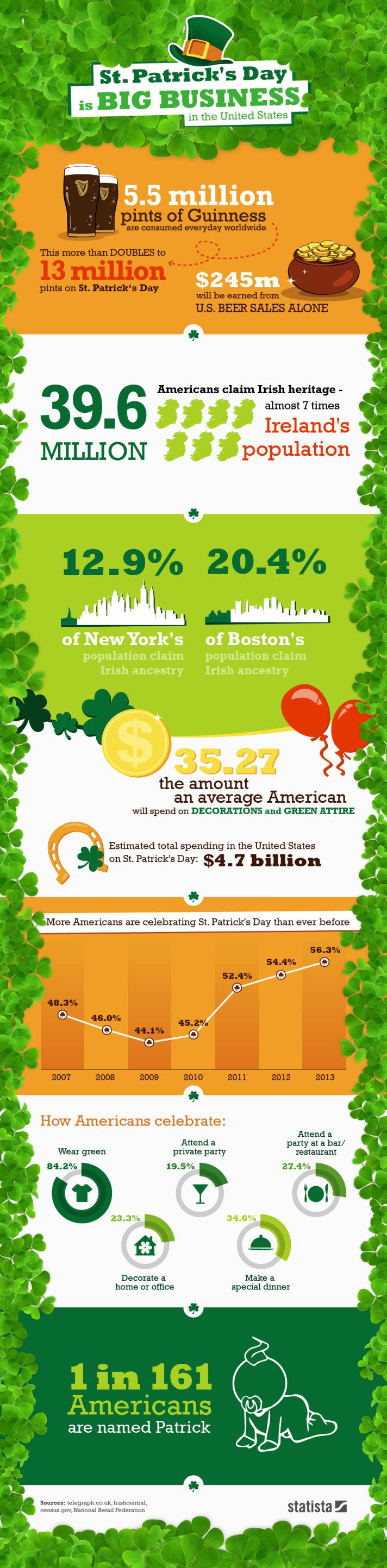
St. Patrick’s Day 2017

aaeaaqaaaaaaaaniaaaajdu2mjhjogi2lwy3zdktndk0mi05zjhklwy1ogriyjexntm1ma

About The Sundance Company
Established in 1976, The Sundance Company has the experience to help you with your commercial real estate needs throughout the Boise Valley. If your requirements include property management, leasing, real estate development, project planning, construction or space planning then look to us. The Sundance Company has more than 1.5 million square feet of office and industrial space available in prime locations in the Boise metropolitan area. More information is available at www.sundanceco.com or 208.322.7300.
Seven Factors of Great Office Design


Smart companies understand that workspaces are a business tool. An office environment reflects and reinforces a business’s core values, through the placement of different teams and functions and design elements that reflect culture, brand, and values.

For example, we’ve seen an explosion of open office layouts, in part because openness, transparency, and collaboration are some of the attributes companies strive for today. Sometimes these designs work well; however, research shows that this collaborative push may be too much of a good thing. Increasingly, people are rediscovering the value of quiet and focus and asking for spaces where they can concentrate.

In fact, collaboration and quiet are two ends of a continuum with a range of in-between work modes — each with an optimal setting. The best way to identify these is to identify everyday work patters and micro-moments that correspond to office design decisions.

This is easier said than done, however. It’s one thing to note a person working solo in an otherwise empty seminar room, or a group of people huddling around someone’s desk because a conference room wasn’t available. It’s quite another to imagine what an alternative, effective scenario might look like.

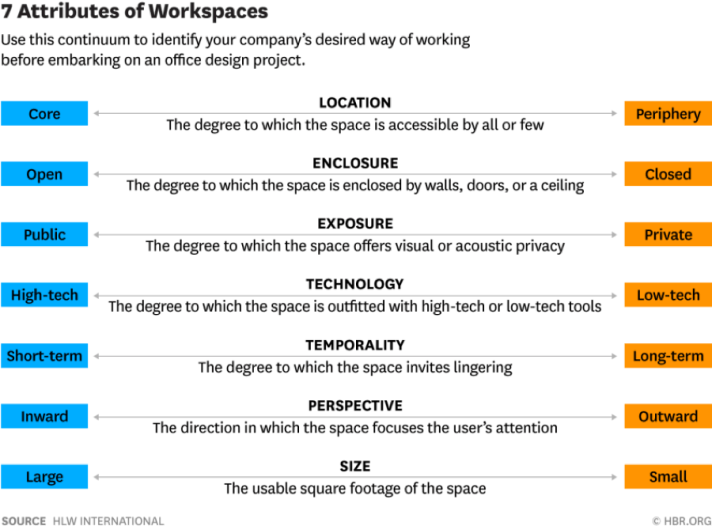
To get everyone speaking the same spatial language, we created a Collaboration and Quiet index consisting of seven attributes that can more concretely enable people to match a desired way of working with a physical space: location, enclosure, exposure, technology, temporality, perspective, and size.

To better understand how these work, try the exercise below on your own or with your team. Pick an example of a work activity that happens regularly, like a daily or weekly standing meeting. Using the continuum below, try to identify the ideals for your particular situation (they will likely fall somewhere between the two extremes on either end). For the attribute “location,” for example, you could ask your team: Is the meeting best facilitated if it’s held in an in-demand central meeting room or near where other people are likely to gather? Or is it best facilitated closer to your team’s work area and away from where you are likely to encounter others?

untitled

When you’re done, consider all your answers collectively — this can help give you the language to identify your needs beyond, say, “We need more collaborative meeting space.”

There are a variety of ways you can use this exercise beyond one meeting. It can serve as the basis of a design visioning workshop with a larger group about how and where people work and how they would envision working in new ways in the future. We created a version of our index as an online survey that feeds us input in a more systematic way and as a means of reaching more people — you could, too, if your organizations are more accustomed to engaging in surveys online rather than in person.

Getting Started

To begin the discussion in your organization, in addition to analyzing the seven attributes with your employees, company leaders should also ask themselves the following questions:

  • Who are our employees, and who will they be in the next 5 years?
  • Who else uses our space (visitors, clients, community members, etc.), and why?
  • How do we want clients, prospective hires, or other visitors to perceive us when they enter our space?
  • To what extent do we value flexibility and choice over how work gets done?
  • Are certain modes of working seen as a privilege only available to a select few?
  • What current workplace behaviors would we like to change?
  • What are the most satisfying attributes of the existing workplace that sustain productivity?

If people aren’t regularly coming to the office, do we understand why not?

The design and outfitting of workspace is a major capital investment for any organization that can affect a number of business outcomes, including productivity, employee satisfaction, engagement, talent recruitment, and brand impact. Given the myriad ways to design and plan a space, leaders should approach workplace design in a strategic way. Imitating the latest fads start-ups are adopting won’t necessarily get you the results your company desires; asking the right questions — and, above all, listening to employees’ answers — will.

The story originally appeared on the HBR website.


About The Sundance Company
Established in 1976, The Sundance Company has the experience to help you with your commercial real estate needs throughout the Boise Valley. If your requirements include property management, leasing, real estate development, project planning, construction or space planning then look to us. The Sundance Company has more than 1.5 million square feet of office and industrial space available in prime locations in the Boise metropolitan area. More information is available at www.sundanceco.com or 208.322.7300.
 

What’s Technology Doing to Commercial Real Estate?

For years, the narrative about the commercial real estate industry’s relationship with technology was one of missed opportunity. While many business sectors quickly latched onto the technological revolution of the 1990s, commercial real estate professionals by and large maintained the status quo for their day-to-day operations, which on some level kept the industry from realizing the benefits of widespread technology adoption.

In recent years, however, the industry has begun to make significant strides. Whether using general enterprise technologies or tools created specifically for the CRE professional, it is increasingly tapping into the digital world to improve processes and create efficiencies. Many dozens of such tools have been created specifically for real estate professionals, from crowdfunding sites to platforms that help investors and brokers leverage advances in big data and virtual reality. With the industry seemingly ripe for disruption, venture capital has flowed rapidly into real estate startups, which raised $1.42 billion from venture capital firms in 2015, according to RE:Tech.

But does this lose sight of the bigger picture for real estate and technology? There’s no doubt that we’ve seen something of a reversal of the industry’s initial aversion to technologies, and as tech-savvy millennials increasingly fill the ranks of its workforce, we can expect this to continue. But the more significant issue is not whether real estate will embrace technology – it’s how CRE can navigate the changes that technology has wrought on the world at large.

Because the new, digital world has affected every commercial real estate asset class – and the impact has frequently presented real estate professionals with significant challenges.

The effect on the retail sector may be most pronounced and is certainly the best known. With the market entry of e-commerce, many retailers have been forced to reduce their physical footprint, and others have closed, leading to increased vacancies across the country in retail assets of all types.

The hospitality sector has similar challenges, because of peer-to-peer replacements like Airbnb. Despite regulatory hurdles in certain municipalities, there’s no denying that Airbnb is effectively increasing the supply of rooms available in many markets. While a boon to tourists and other travelers, the increase has a negative impact on commercial real estate developers and investors.

Office can expect its own share of obstacles. Technologies that support telecommuting continue to be developed, which has created a work environment where face-to-face interaction between different business units is no longer universally seen as essential. As mobile technologies continue to grow in the coming years, and especially as office devotees retire and are replaced by a younger tech-oriented cohort, we can expect the telecommuting trend to lead to shrinking corporate footprints.

Of course, it’s not all bad news. Where retail has begun to wither, the industrial sector has picked up. E-commerce and shipping companies need warehouse and distribution centers to house their operations, and there’s a trend toward converting industrial facilities into office space. This has markedly increased investor interest in industrial properties, and in many markets, industrial development activity has picked up significantly to keep up with booming demand.

And where peer-to-peer hospitality options may pose a threat to the hospitality sector, we can expect them to have a positive impact on multifamily. Apartment leasing can be expected to pick up from both “mini-hoteliers” – i.e. people looking for facilities they can lease out nightly on Airbnb – and young people who will be able to afford their own apartments because of the cash flow they can generate by renting them out intermittently.

To put it simply, adopting the best of today’s enterprise and real estate technology is important – but it’s not enough. Given the rapidly changing world around us, come tomorrow, forward-thinking CRE professionals will have more to contend with than just e-commerce and Airbnb. To remain competitive in 2020, 2030 and beyond, it’s key to stay abreast of major trends — like ride-sharing, autonomous cars and 3D printing — to determine and grapple with their real estate implications. For the long-term, the key is not adopting technology – it’s adapting to it.

This story was originally appeared on the Real Estate Tech News website.

About The Sundance Company
Established in 1976, The Sundance Company has the experience to help you with your commercial real estate needs throughout the Boise Valley. If your requirements include property management, leasing, real estate development, project planning, construction or space planning then look to us. The Sundance Company has more than 1.5 million square feet of office and industrial space available in prime locations in the Boise metropolitan area. More information is available at www.sundanceco.com or 208.322.7300.


6 Effective Ways to Train Your New Hires

You’ve just hired several new employees—congratulations! Find out the most effective ways to train your new hires and make them company superstars.

1. Give Your New Hires Training Manuals
Instructions for company software, a directory of employees and references for resources are all excellent features to include. Online manuals make it easy to add and adjust information and are accessible to your new hires when they are at home

2. Set Your New Hire Up with a Mentor
Mentor programs facilitate relationships, relieve stress for new hires and allow existing employees to become leaders. The mentor can help your new hire with everything, from operating company software to navigating who to talk to get things done, making it easier and less intimidating for your new hire to understand the company.

3. Use an E-Learning Program
Make sure your new hires know commercial real estate. Whether it’s understanding real estate finance, how to use debt correctly or property valuation, you want your new hires to sound like experts when working with clients and partners.

4. Test Your New Hire’s Knowledge
Sure, you can give your new hires all the tools to succeed, but did they actually learn everything they need to know? Find out by quizzing them with Bisnow Education post-video quizzes, similar to this one here.

5. Encourage Questions
Encourage your new hires to ask questions instead of making assumptions. It’s easier to prevent the mess than do damage control. Make this easier by stating no question is a dumb question during those first weeks.

6. Set Your New Hires Free
You hired your new employees for a reason. Trust them, let them flourish and avoid micromanagement. They may not be perfect at first, but with time, they’ll learn the system and some of them will become your superstars.

This story was originally appeared on the Bisnow website.

About The Sundance Company
Established in 1976, The Sundance Company has the experience to help you with your commercial real estate needs throughout the Boise Valley. If your requirements include property management, leasing, real estate development, project planning, construction or space planning then look to us. The Sundance Company has more than 1.5 million square feet of office and industrial space available in prime locations in the Boise metropolitan area. More information is available at www.sundanceco.com or 208.322.7300.