2015: Best Year For U.S. Office Sales Since 2007


U.S. office net absorption topped 100 million square feet for the first time since the Great Recession and the national office vacancy rate declined another half-percentage point in 2015 as broadening demand and constrained levels of construction contributed to tightening space availability in virtually every metro area.

The U.S. office vacancy rate declined from 11.3% in 2014 to 10.8% at the end of 2015, continuing its downward trend from the 13.2% vacancy rate at the worst of the economic downturn, according to data presented at CoStar’s recent State of the U.S. Office Market 2015 Review and Forecast.

Vacancies declined in 64% of the nation’s office submarkets and 56% of metro office markets during the fourth quarter of 2015. CoStar analysts expect office vacancy to continue trending lower to approximately 10% in 2017.

“The market is overwhelmingly strong at this point in the cycle. With the momentum in the market, I’m sure the next quarter will also be strong,” said Hans Nordby, managing director of CoStar Portfolio Strategy, who presented the findings along with CoStar Director of Office Research Walter Page and Vice President and Research Director Dean Violagis.

The strong metrics fueled a white-hot investment market, with preliminary office asset sales up nearly 18% in 2015 to $152 billion, Violagis said.

Atlanta, Miami and Nashville were among the markets showing the largest annual vacancy improvement. Each showed larger vacancy decreases than San Francisco, Seattle and Boston, demonstrating a momentum shift in office market strength from the technology and energy metros that have driven the economy’s recovery and expansion to markets that suffered during the recession era housing bust. San Francisco’s vacancy rate declines showed evidence of slowing in the fourth quarter as new office supply began to enter the market, Page said.

Unsurprisingly, Silicon Valley markets posted the strongest annual occupancy gains. That said, 8 of the 13 markets with the highest year-over-year changes in occupancy are not driven by either energy or technology, much different than just a year ago, Nordby said.

“Big-tenant markets like Atlanta and Dallas are doing well. It’s their turn,” he said.

While consumers are enjoying lower prices at the gas pump, some parts of the U.S. and parts of the economy are feeling pressure from global economic volatility along with falling energy prices and their ripple effect in equities markets, Nordby said. The S&P 500 has fallen about 11% since peaking last May, due in part to the weakness in energy-related stocks.

Tech Sector Warning Signs

Technology stocks are down more than 10%. Large companies such as Apple and Samsung Electronics last week warned that global economic turbulence and declining demand will slow the tech sector during 2016.

Sunnyvale, CA-based Yahoo’ CEO Marisa Mayer announced plans to eliminate another 1,700 jobs, or 15% of its workforce; along with other measures such as the sale of surplus real estate and closing of five global offices. Yahoo will also explore “strategic alternatives” to potentially sell or spin off its core search engine and web portal business. The company last month was reportedly marketing a 48-acre parcel originally slated for expansion in Silicon Valley near Levi Stadium in Santa Clara.

“Tech is volatile. It feels good until it doesn’t’ feel good at all,” Nordby said, adding that it’s unclear at present when or if lower private and public market valuations might affect hiring in high-tech bastions such as San Jose, San Francisco, Boston, Raleigh, Austin and Seattle.

However, the strong momentum from last year’s strong showing in the office sector and throughout commercial real estate markets is expected to carry well into 2016, the CoStar economists said.

Annual net absorption of office space increased to 101 million square feet in 2015, compared with 93 million square feet in 2014, while developers delivered 64 million space feet, a 41% increase over the previous year. The amount of new space under construction, which has trended downward in the last couple of quarters, stood at 126 million square feet at year end, a modest 7% increase from a year ago, and near the historical yearly average since 2000.

2015’s 4.4% annual rent growth topped the previous year’s growth of 3.8%, with rents surging at a particularly strong rate in CBDs such as San Francisco at 19.4% and Raleigh, NC at 13.9%. Even in the urban core of Atlanta and Detroit, rents in the urban core rose at 11.2% and 10.5%, respectively.

The story originally appeared on the Costar website.

About The Sundance Company
Established in 1976, The Sundance Company has the experience to help you with your commercial real estate needs throughout the Boise Valley. If your requirements include property management, leasing, real estate development, project planning, construction or space planning then look to us. The Sundance Company has more than 1.5 million square feet of office and industrial space available in prime locations in the Boise metropolitan area. More information is available at www.sundanceco.com or 208.322.7300.


Drone Photography is Changing How We Approach Real Estate


Aerial photos and video shot by drones are adding a cutting edge element to the luxury real estate market, giving a field that is already highly competitive a touch of Hollywood style production.

Digital Journal caught up with Douglas Thron, a San Francisco Bay Area based professional drone cinematographer whose four minute video on a high end property in Santa Barbara was recently placed on Placester.com’st of the top 10 Most Stunning Real Estate Listing Videos of 2015.

“There is no better way to capture the unique setting and features of a home than through the aerial shots and video that a drone can produce,” Thron says.

“My videos are like mini- movies,” he tells Digital Journal.”I start with an intro that showcases the entire area so that potential buyers can get a complete idea of the community and natural surroundings before zooming into the home and detailing the interior.”

An FAA seaplane licensed pilot, Thron says he switched shooting from small planes to drones because they are more cost effective and maneuverable in a populated area. He also shoots nature films for the Discovery Channel, where the drone allows for less intrusive shots of wildlife in action from dynamic perspectives — he recently filmed Great White sharks off the coast of Northern California.

Drone Photography Sells Houses

With many high end real estate buyers shopping for properties well out of their area, high-definition drone videos are effectively virtual tours in the palm of the hand. According to the Commercial Real Estate Development Association (NAIOP) drone videos allow potential investors to see every inch of their property, including pitfalls and problems, right at the initial phase of the deal. This makes brokers who offer aerial drone videos more attractive to buyers.

“The benefit for both the buyer and the seller is obvious,” Thron tells us. “The relative low cost of hiring a professional drone pilot to come in and shoot the property for the day translates immediately into a much higher chance of sale with an interested client.”

The story originally appeared on the Business Insider website.

About The Sundance Company
Established in 1976, The Sundance Company has the experience to help you with your commercial real estate needs throughout the Boise Valley. If your requirements include property management, leasing, real estate development, project planning, construction or space planning then look to us. The Sundance Company has more than 1.5 million square feet of office and industrial space available in prime locations in the Boise metropolitan area. More information is available at www.sundanceco.com or 208.322.7300.
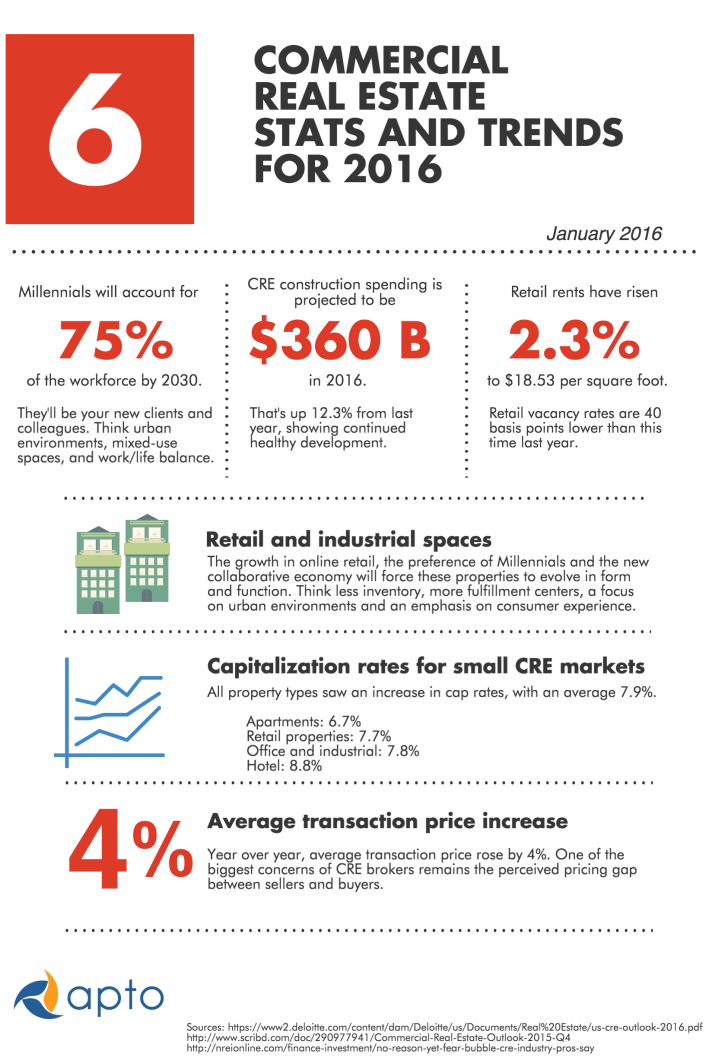


March Madness 2016

mad-about-march-madness_50291575bb748_w1500

About The Sundance Company
Established in 1976, The Sundance Company has the experience to help you with your commercial real estate needs throughout the Boise Valley. If your requirements include property management, leasing, real estate development, project planning, construction or space planning then look to us. The Sundance Company has more than 1.5 million square feet of office and industrial space available in prime locations in the Boise metropolitan area. More information is available at www.sundanceco.com or 208.322.7300.

 

Commercial Real Estate Tech Predictions


The second wave of CRE tech is barely three years old. In that time, the landscape has evolved astonishingly fast, with dozens of new companies formed and hundreds of millions of dollars of venture capital invested in the space. Given how quickly things are moving, it’s tough to predict what’s in store for 2016. Here are 5 things I expect to happen with CRE tech:

Prediction #1: CRE tech goes mainstream

After a decade of stubborn resistance, 2016 is the tipping year where the CRE industry fully embraces cloud technology and mobility to drive efficiency and create competitive advantage. Those still married to their Excel spreadsheets will start to feel the FOMO (that’s Fear Of Missing Out, for you traditionalists) of not having data at their fingertips, as they see leading commercial landlords and brokerage firms adopt ahead of them. That list already includes the likes of CBRE, Vornado, Kilroy, Shorenstein, Beacon Capital, Starwood, Rudin, Silverstein, CREIT, Newmark Knight Frank and hundreds of other leading brands who’ve adopted the Hightower platform.

More specifically, 1-2 of the new software categories will rise above the noise to become industry standard. Leasing management will lead this charge, and could be joined by test fit automation, and bid management. Hightower stands as a good barometer of this shift, with our business  growing by 68% in Q4 alone.

Prediction #2: We see the first major wave of CRE tech M&A

With over 100 companies trying to “disrupt” commercial real real estate, the second half of 2016 will bring with it a shakeout in CRE tech. I expect to see 2-3 M&A deals, as new CRE tech firms merge due to product/market overlap, or as larger technology incumbents try to catch up by acquiring newer technologies.

Prediction #3: There will be a flight to quality in venture financing

For the past 3 years, CRE tech has grown in a favorable fundraising environment, with investors spreading small bets across many players. That will change in 2016 as the largest market opportunities (and leaders) for CRE tech solidify and the financing markets tighten. The result will be far fewer early stage financings (Seed and Series A), and a flight to quality as investors look to line up behind companies they believe can win those transformative opportunities. The companies below the cusp are the likely candidates for the M&A activity discussed above.

Prediction #4: A major partnership between old guard and new guard CRE tech companies

2016 will bring the first of several blockbuster partnerships between a new wave CRE tech startup and major CRE technology incumbent that drives significant value to a broad audience of customers. This success will push other incumbents to integrate with new players who show demonstrated traction in the market, kicking off a dramatic industry shift from technology silos to an ecosystem of platforms communicating through API’s.

Prediction #5: CRE tech goes global, and fast

The last of my CRE tech predictions is that the leading companies will expand internationally and do so much faster than expected. The drivers will be demand from an increasingly global audience of CRE owners and brokerages who expect their technology to cross borders with them, and the inherent scalability of cloud technology enabling rapid expansion into international markets.

The story originally appeared on the Hightower website.

About The Sundance Company
Established in 1976, The Sundance Company has the experience to help you with your commercial real estate needs throughout the Boise Valley. If your requirements include property management, leasing, real estate development, project planning, construction or space planning then look to us. The Sundance Company has more than 1.5 million square feet of office and industrial space available in prime locations in the Boise metropolitan area. More information is available at www.sundanceco.com or 208.322.7300.


The Social Media Effect on Commercial Real Estate

Social networking functions as the primary utility for one of the most important aspects of real business growth: relationship management. The commercial real estate industry is making strides embracing digital relationship management and transparent access to information. However, compared to other industries who have established strong social media best practices, the commercial real estate industry is in an early adoption stage.  The big question is how important is social media to the future of facilitating real estate deals? Let’s examine three recent CRE market trends to see where and if these social media waves are driving real business growth.

CRE tech catching up to cutting edge tech.

The Counselors of Real Estate, an 1,100 member real estate advisory community, recently held a panel discussion in Charlotte North Carolina. Two of the seven takeaways pertained specifically to the Internet’s rapid effect on the commercial real estate space:

  • With the right infrastructure, the center of the world can be anywhere Much of the internet’s effect starts with interconnectedness and transparency. In CRE, the availability of capital, the access to listings, and information sources to vet deals are at an all time high.
  • Without a social media presence your network effect is limited and the ability to pass a vetting is diminished. Every firm in of itself is a community of contacts, customers, employees, and all their contacts customers, and employees. Without a community, who will you do business with? In CRE, you must open the online doors so your offerings can be found.

Where you can share an image, you can show a property.

“You can tell a good story with a visual,” said Paige Steers, a Jones Lang LaSalle (JLL) spokeswoman. “If I’m selling a building or leasing space and I have a beautiful photo that says it’s the first time on the market and it’s eye-catching, it will be shared and it will be spotted.”

This social network’s supreme reliance on images yields itself nicely to understanding what a building offers in a short period of time. Peter Grant describes Instagram as “the preferred social-media tool for many New York residential real-estate brokers.“

It’s no surprise to see more real estate activity on the site. While Instagram can no doubt help with a firm’s branding and community development, will we see it emerge as a primary lead generation channel? Are commercial real estate brokers ready to say, ‘I can’t do my next deal without Instagram?’ And before you go head over heels thinking that Instagram is the top social media platform in CRE, know that JLL still doesn’t list Instagram as one of the company’s primary social networks on its own homepage.

The influx of ardent Gen-Y brokers

Author Stand Bullard tells a story of how this monthly young broker’s happy hour grew from 3 to 25 people, serving as a microcosm for the increased demand of 20-somethings becoming commercial real estate brokers in the Cleveland area. For what the piece is lacking in hard data, it is surfacing in anecdotes. The happy hour is officially called, “No Old Dudes or Dudettes.”  The article also implies that twenty-somethings brokers are outnumbering thirty-somethings brokers in the Cleveland area.

To get a deal done – from marketing a property to evaluating a property to building the right team – brokers are banking on social media. While the core of real estate is quite literally brick and mortar, the commercial development of new business demands a more modern approach.

The story originally appeared on the Capstak website.

About The Sundance Company
Established in 1976, The Sundance Company has the experience to help you with your commercial real estate needs throughout the Boise Valley. If your requirements include property management, leasing, real estate development, project planning, construction or space planning then look to us. The Sundance Company has more than 1.5 million square feet of office and industrial space available in prime locations in the Boise metropolitan area. More information is available at www.sundanceco.com or 208.322.7300.


What to expect in workplace design in 2016


Knoll Inspiration sat down with Tracy Wymer, Vice President of Workplace Research & Strategy at Knoll, to review 2015 and look forward to the year ahead. Read on to learn how co-working culture will influence more traditional workspaces, why what’s good for people is good for organizations, and why there is no such thing as one-size-fits-all.

What trends will have the most impact on workplaces in 2016? Hospitality, technology and great design.

  1. Hospitality

Workplaces are being positioned almost as hotels with really good concierge service. So many businesses have such distributed workforces, and with flex work expanding around the globe, people and content are flowing in and out and through a building at new rates. How do you manage that flow, and how do we attract people to stay? All of a sudden, we see inspiring design and programmatic elements that welcome and keep people in a space, everything from cafes and lounges to company versions of the Ace Hotel lobby. Corporate facilities are exploring how to bring co-working culture in. How do we make the workplace more hospitable, and how do we foster an organization’s culture?

  1. Technology Networks

We’re just scratching the surface of technology’s potential in the workplace’s social network. We can start to understand individual preferences: where you like to sit, if it’s a free address model, and that you like a flat white coffee. And we can start to communicate these preferences, these networks. So how can visual display show an active network of the workplace, allowing other people to know if you’re present and may be available? This information and its communication can help to bring people together who can benefit from being in the same place. It’s this kind of ‘serendipity’ that is so crucial to innovation and creativity.

  1. Great Design

Design is taking a more and more central role in the workplace. I come from the Bay Area, where it’s almost a mandate to provide high quality workspace; it’s seen as a key support for the kind of creativity, innovation and collaboration that are so critical to Bay Area industries. The value of good design for productivity and innovation is being picked up around the globe and adopted by more and more companies, not just the tech or obviously creative ones. We really need to provide more compelling workspaces, especially as everyone is competing for the same talent. And this means supporting a variety of work styles within the same office.

The story originally appeared on the Knoll website.

About The Sundance Company
Established in 1976, The Sundance Company has the experience to help you with your commercial real estate needs throughout the Boise Valley. If your requirements include property management, leasing, real estate development, project planning, construction or space planning then look to us. The Sundance Company has more than 1.5 million square feet of office and industrial space available in prime locations in the Boise metropolitan area. More information is available at www.sundanceco.com or 208.322.7300.


What Happens In An Internet Minute?


About The Sundance Company
Established in 1976, The Sundance Company has the experience to help you with your commercial real estate needs throughout the Boise Valley. If your requirements include property management, leasing, real estate development, project planning, construction or space planning then look to us. The Sundance Company has more than 1.5 million square feet of office and industrial space available in prime locations in the Boise metropolitan area. More information is available at www.sundanceco.com or 208.322.7300.

The Next Generation of Social Media in the Office

When you need to get a message to a colleague, what’s your preferred mode of communication? Do you dash off an email, pick up the phone, or maybe send an instant message via the company’s intranet? A lot has changed since the era of interoffice memos, and how you choose to communicate could well be a generational choice. According to a new study from Peter W. Cardon at the University of Southern California and Bryan Marshall at Georgia College, age differences increasingly result in sharp divergences in how employees connect and correspond with one another. And these differences present a challenge for businesses seeking to implement advances in communication methods while still extracting value from the knowledge-sharing activities of employees from all age groups and with varying levels of technical proficiency.

Email still reigns supreme in the workplace, the authors found, but social media networks are poised to take over. Thus, companies should start thinking about integrating new technological platforms, indoctrinating older workers into newer communication streams, and establishing guidelines for how employees interact with one another. Although social networking sites were first embraced solely by the younger generation in the early 2000s, they’ve since become mainstream. As of 2014, 74 percent of adults in the U.S. — and half of those older than 65 — use public social networking platforms such as Facebook and LinkedIn.

As the use of public social networking sites has grown, so, too, have company-designed platforms, hosted on the corporate intranet and designed for better workplace communication. Several major software vendors — including Microsoft, Oracle, and SAP — produce social network platforms for companies, which include instant messaging programs, file-sharing sites, Facebook-esque interfaces, and RSS feeds. But what does it mean for the office if discussions around the watercooler have been supplanted by in-house blogs, message boards, and wikis?

A wealth of analysis exists about the technical challenges of implementing social networks, but researchers have yet to compare the value of these new communication platforms with that of traditional channels. Aiming to fill the gap, the researchers surveyed a wide cross-section of business professionals about the frequency with which they use traditional channels versus Web 2.0 platforms, the effectiveness of various communication formats, and their attitudes about using social media for team interaction.

The authors grouped participants into three generations: gen Y (21- to 30-year-olds), gen X (31- to 50-year-olds), and baby boomers (51- to 65-year-olds). Employees at companies that host dedicated social networks are much more likely to use nontraditional modes of communication, the authors found, and tend to share documents through wikis, send instant messages, and post to in-house message boards far more frequently than their colleagues at firms without a social networking infrastructure. This is especially true of the gen Y group: About 71 percent reported using wikis or document-sharing sites regularly, and 57 percent communicated with colleagues via instant messaging daily.

But workplace social media platforms still face an uphill climb. Although exposure to corporate social networking engenders optimism about its future, most employees remain wary of it. Even among the most enthusiastic demographics — gen X and gen Y employees with access to company-wide social networks — only half expected it to become the prevailing form of communication, and most didn’t think it improved their work or interaction with colleagues.

In fact, the authors conclude, even if firms implement new communication platforms, that doesn’t mean they can close down the conference room or eliminate landlines. Overall, the study found, employees and managers of all ages still regard traditional methods — such as face-to-face conversations, phone calls, and email — as the most effective means of communication, regardless of whether they had company-wide social networks available to them.

And for the next few years at least, email in the workplace will remain king. More than 85 percent of employees with access to social networks still used email hourly, and 83 percent considered it effective. Even 90 percent of gen X and gen Y professionals said they preferred email, whereas only 42 percent considered texting or instant messaging to be effective for communicating with team members.

That said, it won’t take much to push workplace social media platforms further into the mainstream. The technology is still nascent — only 26 percent of the survey participants worked at firms with social networking infrastructure — but the number of employees who express enthusiasm about the benefits of team communication could herald a major shift. The authors speculate that Web 2.0 channels could overtake email within the next decade.

As the number of younger professionals in the workforce swells, using instant messaging or posting to a message board could be as commonplace as sending an email or drafting a memo. The challenge for companies is to keep their employees on the same (wiki) page and ensure that all sections of the workforce can communicate in effective, efficient ways — no matter what the technological platform

The story originally appeared on the strategy+business website.


About The Sundance Company
Established in 1976, The Sundance Company has the experience to help you with your commercial real estate needs throughout the Boise Valley. If your requirements include property management, leasing, real estate development, project planning, construction or space planning then look to us. The Sundance Company has more than 1.5 million square feet of office and industrial space available in prime locations in the Boise metropolitan area. More information is available at www.sundanceco.com or 208.322.7300.

2016 Marketing Trends

151215-2016-marketing-trends-infographic


About The Sundance Company
Established in 1976, The Sundance Company has the experience to help you with your commercial real estate needs throughout the Boise Valley. If your requirements include property management, leasing, real estate development, project planning, construction or space planning then look to us. The Sundance Company has more than 1.5 million square feet of office and industrial space available in prime locations in the Boise metropolitan area. More information is available at www.sundanceco.com or 208.322.7300.

Where Will Social Media Users Go in 2016?

About The Sundance Company
Established in 1976, The Sundance Company has the experience to help you with your commercial real estate needs throughout the Boise Valley. If your requirements include property management, leasing, real estate development, project planning, construction or space planning then look to us. The Sundance Company has more than 1.5 million square feet of office and industrial space available in prime locations in the Boise metropolitan area. More information is available at www.sundanceco.com or 208.322.7300.